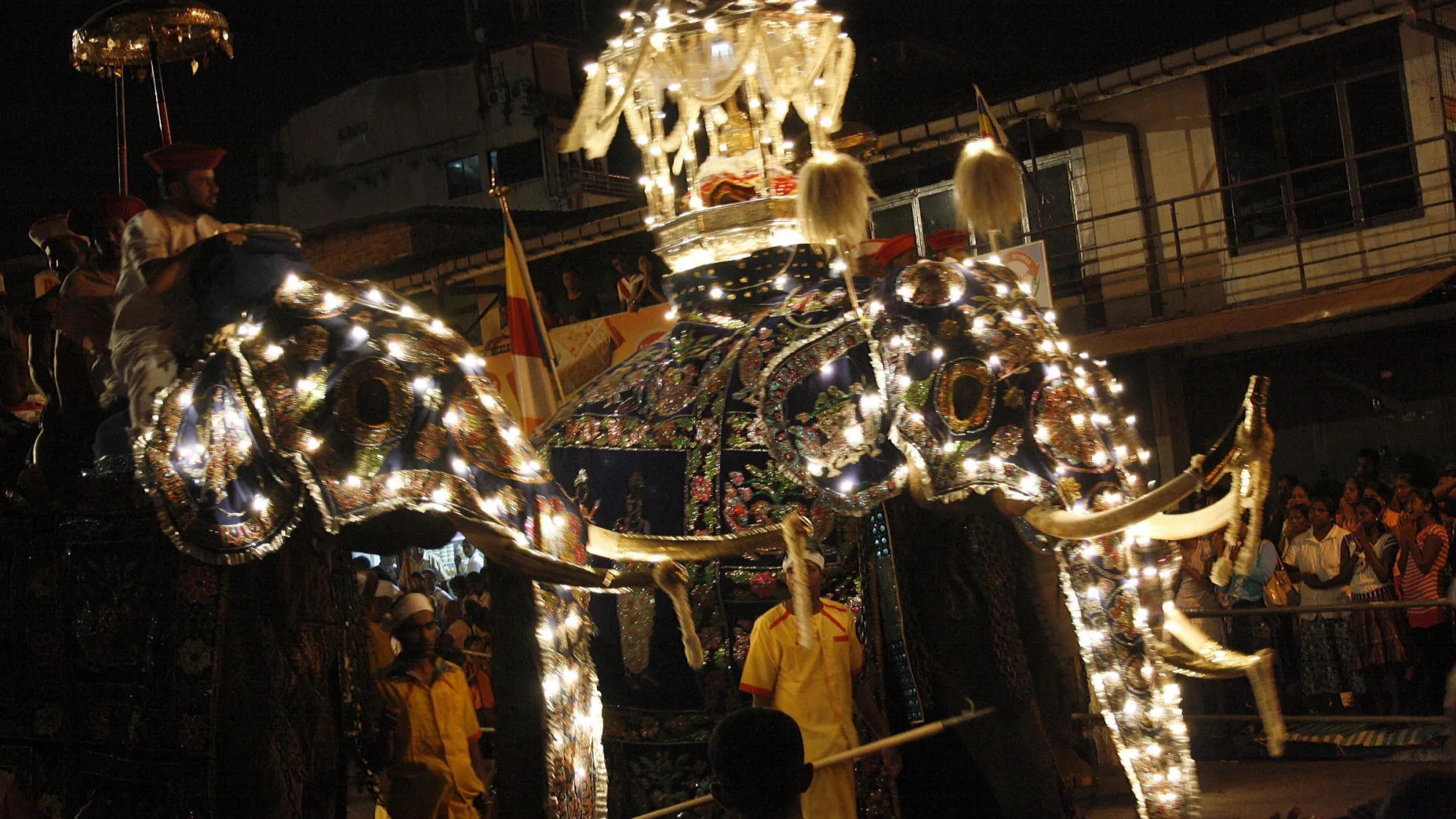
The Esala Perahera in Kandy is the largest Buddhist procession in Sri Lanka and among the oldest continuously performed festivals anywhere. It runs for ten nights and ends on the Nikini full moon poya, which falls in July or August.
It is genuinely extraordinary, and it is also the single hardest thing in Sri Lanka to arrange at short notice.
When it happens
The dates are set by the lunar calendar and change every year. They are usually confirmed only a few months ahead, which is unhelpful when the accommodation you need books out twelve months in advance.
The practical approach is to plan for late July or early August, book refundable accommodation as early as you can, and confirm the exact nights when the temple announces them.
What actually happens
Each night a procession leaves the Temple of the Sacred Tooth Relic and moves through the streets of Kandy. The order is fixed: whip-crackers clearing the way, then flag bearers, fire dancers, Kandyan drummers and dancers, and finally the Maligawa tusker — an elephant in an illuminated caparison — carrying a replica of the relic casket.
Four more processions from the Natha, Vishnu, Kataragama and Pattini temples join it. On the biggest nights there are upwards of fifty elephants and a thousand performers.
The processions build over the ten nights. The first, the Kumbal Perahera, is comparatively modest. The final nights, the Randoli Perahera, are the ones people travel for.
Booking, honestly
Kandy has a finite number of hotel rooms and they go a year ahead for the final nights. Prices multiply. This is not something you can arrange on arrival.
Seating on the route is sold separately, through hotels, agents and the shops and offices whose balconies overlook the street. Prices vary enormously and so does the view — ask specifically which street and which floor before you pay.
Where to sit
The route runs along Dalada Veediya and Yatinuwara Veediya. Higher is better: a first-floor balcony is worth considerably more than a street-level chair behind three rows of standing people.
Arrive at least three hours before the advertised start. The streets close, the crowds are enormous, and once you are in you are not leaving until it has passed. Take something to sit on and expect a long wait. The processions often start late and run past midnight.
A note on the elephants
The use of elephants in the perahera is contested in Sri Lanka itself, and conditions for the animals have been criticised by welfare organisations. Some travellers choose not to attend for that reason, and that is a reasonable position. We will tell you what we know if you ask rather than pretending the question does not exist.
If you cannot get in
Several smaller peraheras run around the same time and are far easier to attend: Kataragama in the south-east, Bellanwila and Kelaniya near Colombo, and Devinuwara on the south coast. None matches Kandy for scale, but you will actually see them, and you will not have booked a year ahead to do it.
Planning a trip? Have a look at our cultural triangle tour, or every package we run.